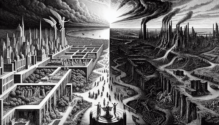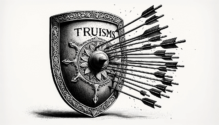
We have lost the ideal of conviction.
It once led men to discover and settle new worlds.
But now, it is viewed as irrational.
– Every Angel is Terrifying, Praxis

Having more of something makes it seem less important.
We see it when it comes to charity—people are more moved (and tend to give more money) when focusing on the suffering of a single individual.
If a person’s compassion were based on the amount of suffering taking place, one would think adding another suffering individual to the picture would increase their level of compassion.
But research shows the opposite is true—we feel less sympathy for a school of suffering children than we do a single mourning child.
(as the grim saying goes, “One death is a tragedy; a million deaths is a statistic”.)
There is a parallel here to the significance of an individual in a small village versus one within a world of seven billion people.
In smaller communities of the past, a dominant belief system provided a foundational compass, especially noticeable as children.
The faces we recognise, the stories we hear, the values we absorb—there wasn’t much variation. Within the confines of a family unit, it’s likely there was a single religion and a shared moral compass.
As one transitions into the broader world of young adulthood, the picture changes. A myriad of cultures, both past and present, come into view.
Suddenly, you’re confronted with a dizzying array of belief systems and lifestyles. Each appears valid and justified by its followers.
While it might be easy to dismiss ancient beliefs as primitive and inferior to those of modernity, we’re still left to navigate a wide range of contemporary perspectives.
(although it begs the question: if past beliefs don’t fair well by today’s standards, what makes us think future generations will look kindly upon ours?)
Our interconnected world promotes the notion that all perspectives hold value. But different interpretations of reality may be better or worse at producing certain outcomes.
Consider two societies—
- Society A views weather events as omens from the divine, using rituals for protection.
- Society B uses atmospheric science to anticipate and prepare for weather changes.
If you value human life, Society B’s interpretation of weather is the better choice.
Hence if we value certain outcomes (e.g. minimising human suffering), then not all viewpoints are equally valid.
From the perspective of an individual’s psychology, a blanket acceptance of all viewpoints can be deeply destabilising. The human psyche thrives on a certain level of structure and foundation.
In earlier times, this foundation was provided by the dominant belief system of one’s family or village. It acted as a compass, guiding individuals through life’s many challenges, moral dilemmas, and existential questions.
But in our modern, interconnected world, where an abundance of belief systems and perspectives are readily accessible, this compass often spins wildly, with no fixed direction.
While it’s liberating to have access to a varied range of ideas, it also means that one’s convictions are constantly challenged. The risk is that individuals become paralysed by the sheer variety of perspectives, leading to a kind of philosophical stagnation.
The post-modern critique that all perspectives are equally valid seems egalitarian on the surface, but it can also strip away the very foundations upon which individuals build their identities.
By suggesting that any interpretation of reality is as good as any other, we risk creating a society where there’s a hesitation to stand up for what one believes in, for fear that it’s no more valid than any other perspective.
Keeping an open mind and being humble helps us learn. We can still listen to other’s views and adjust our convictions when presented with compelling evidence.
But there’s a difference between staying open-minded and losing oneself in a vast sea of opinions.
You have to distinguish between insightful criticism that helps refine your convictions, and the noise that dilutes them.
We can value our interconnected world’s rich tapestry of perspectives while recognising the need for a personal anchor.
This anchor, grounded in introspection and critical thinking, ensures that while we sail in this vast ocean of opinions, we don’t lose sight of our own convictions.